The update particularly strengthens structured exposure therapy through improved interactivity, more realistic simulations, and more precise stimulus control.
The following video provides a compact overview of the most important new features.

With the Compulsion App, the VR Coach smart system now includes specialized VR scenarios for ordering compulsions, washing compulsions, and hoarding disorder. The module is designed for Exposure and Response Prevention (ERP) and supports therapists in the structured treatment of obsessive-compulsive disorder within a virtual setting.
The scenarios are fully interactive. Patients actively perform actions and experience the resulting tension in a controlled environment.
Patients deliberately place books or objects “incorrectly” and tolerate the resulting tension. Through active behavior within the environment, exposure becomes not only cognitive but also behavioral. Therapists can adjust intensity and progression situationally.
In a train station hall, contamination-triggering situations are deliberately created. Patients, for example, pick up an object from the floor and then look at their supposedly contaminated hands — without engaging in their usual neutralizing behavior. The immersive environment enhances emotional activation and supports response prevention training.
Objects such as magazines are deliberately discarded. Throwing items away is not only discussed but actively performed. This active process facilitates the learning of alternative behavioral strategies.
The car scenario has been technically and visually revised to enable more realistic exposure for anxiety disorders.
Surrounding vehicles now react dynamically to the driving situation. The AI-controlled traffic flow creates less predictable, realistic scenarios that can be used therapeutically.
Patients can now slowly enter a tunnel. Controlled entering and exiting of a traffic jam is also possible. These smooth transitions allow finely graded stimulus increases within exposure therapy and support precise adaptation to the individual stress level.
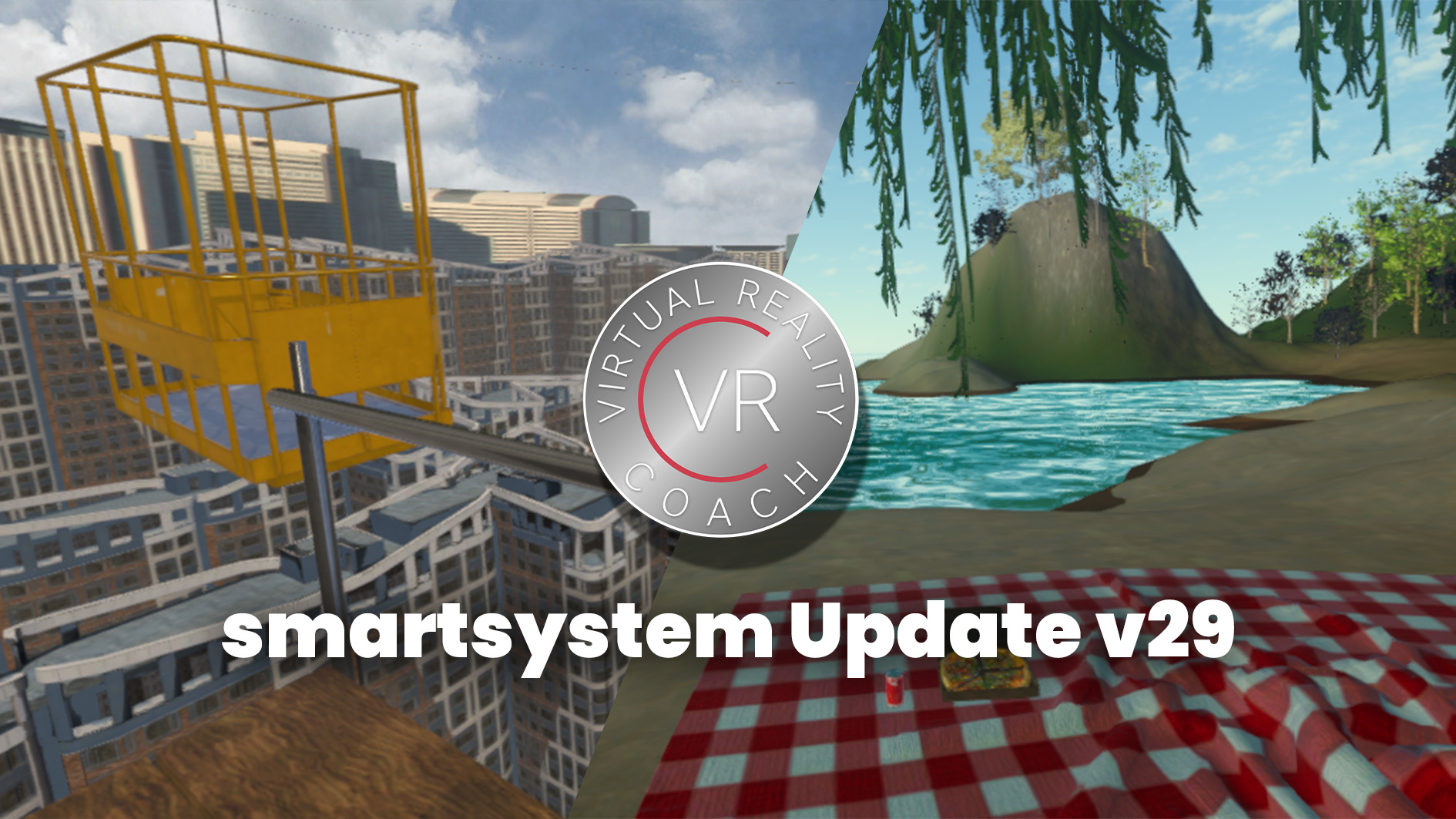
Therapists can gradually adjust the plank to be narrower or longer, thereby increasing or decreasing the challenge in a controlled manner. The change occurs directly within the VR scenario and is immediately visible. This allows exposure to be precisely adapted to the course of therapy and systematically integrated into an existing hierarchy.
This enhancement improves individualized control within VR exposure.
A new mirror has been implemented in the eating disorder module, allowing smoother rotation movements. Body representation has been refined, making adjustments appear more realistic.
The differentiated representation supports therapeutic work on body schema disturbances and distorted self-perception and improves the clinical applicability of the VR scenario.
The AI feature of the VR therapy software has been functionally expanded.
VR content can now be generated in higher resolution, allowing clearer details and increased visual immersion.
With the new extension button, existing videos can be specifically expanded. Additional text prompts allow flexible extension of scenes without recreating them. This enables content to be individually tailored to therapeutic questions.
The update of the VR Coach smart system expands VR therapy for obsessive-compulsive disorder with the new Compulsion App and optimizes existing VR scenarios for anxiety, height exposure, and eating disorders. This is complemented by functional expansions in the AI area.
Focus areas include:
structured exposure in a virtual environment
improved interactivity
more realistic simulations
more precise therapeutic control

Our users consistently confirm the very high quality and realism of the 3D graphics. Unfortunately, this quality cannot be fully conveyed through simple images on the website.
The screenshots shown are intended only to illustrate and demonstrate the content.

Our users consistently confirm the very high quality and realism of the 3D graphics. Unfortunately, this quality cannot be fully conveyed through simple images on the website.
The screenshots shown are intended only to illustrate and demonstrate the content.
Wir nehmen demnächst mit Ihnen Kontakt auf.
Ihr VR Coach-Team
We will be happy to get in touch with you soon!
Your VR Coach team
Would you also like to test our content for depressions, eating disorders and compulsions free of charge?