How realistic is Virtual Reality?
“Is it realistic enough for patients?”
However, this impression arises because images and videos cannot convey the actual experience of being in Virtual Reality.
Screenshots do not show what VR feels like.
Realism mainly comes from spatial presence and immersion.
Patients experience situations in VR not only visually but also physically and emotionally.
For exposure therapy, it is crucial that reactions arise in the here and now.
How realistic VR feels is usually understood best through direct personal experience.
Key points at a glance
Why screenshots only partially show the realism of VR scenarios
A screenshot shows only a single two-dimensional fragment of a virtual environment.
Inside the VR headset, the impression is very different: patients experience the situation spatially, can look around, move within it, and perceive themselves as part of the environment. This experience is described as presence and is a central component of immersion.
Therefore, the key point is not how a single image looks, but how believable the situation feels inside the VR headset.
Postcard or real place? A simple comparison
A simple example illustrates this difference.
A postcard with a photo of a beach can look very realistic. Yet no one has the feeling of actually standing on the beach.
When you truly stand on the beach, the experience is immediately different: you perceive the environment spatially, move within it, and experience the place directly.
Virtual Reality works in a similar way:
A screenshot is like a postcard.
The VR headset creates the feeling of actually being in the situation.
Why VR scenarios feel real: presence, movement, and interaction
In virtual scenarios, patients do not simply look at an image.
They can orient themselves within the environment, move around, perceive objects and—depending on the application—interact with elements of the environment. This creates a high level of immersion: the situation is not just observed, but experienced.
Modern applications may also include dialogue elements. In some scenarios, conversations with virtual characters are possible, sometimes supported by modern AI technology. This can make the experience even more immediate and closer to everyday life.
This combination of spatial presence, movement, interaction, and immersion makes Virtual Reality particularly suitable for exposure therapy.
Studies on the realism of VR therapy
The realism of virtual scenarios has also been investigated scientifically.
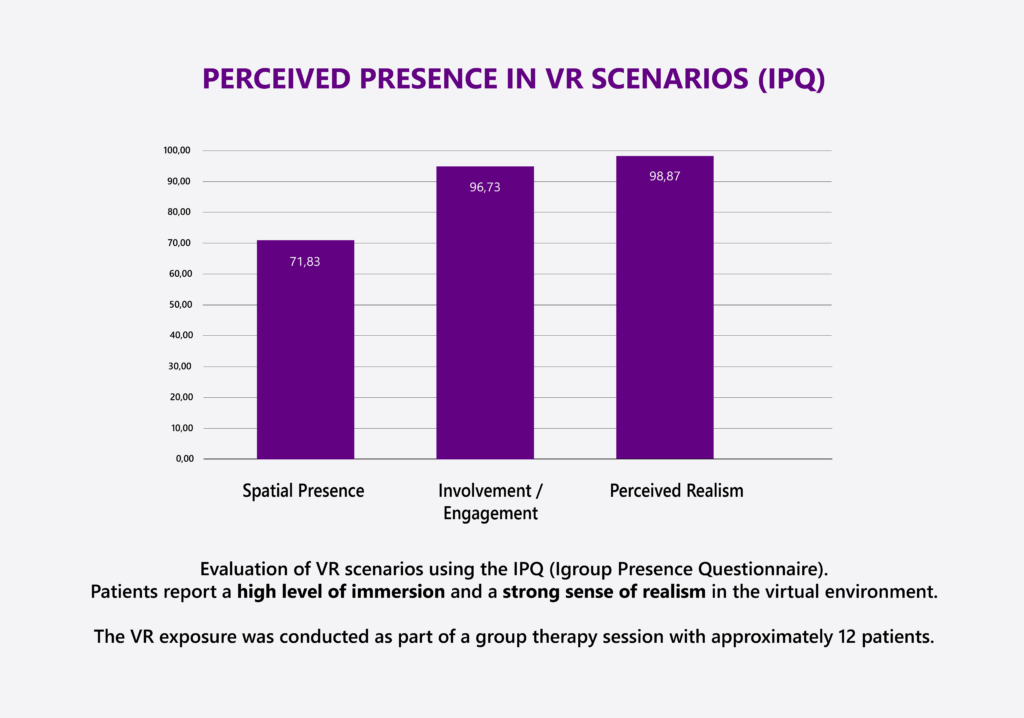
At the Anton Proksch Institute in Vienna, researchers examined spatial presence and perceived realism of VR scenarios among patients. The scenarios used in the study were taken from the VR Coach smartsystem.
The results show:
- VR creates strong immersion
- Patients experience the situations as realistic
- The method has very high acceptance
Virtual Reality can therefore produce intense and credible experiences, even though the scenes are computer-generated.
Wie realistisch ist Virtual Reality? Erkenntnisse aus der Praxis
Die Frage, wie realistisch Virtual Reality ist, wird nicht nur theoretisch diskutiert, sondern auch empirisch untersucht.
Am Anton Proksch Institut in Wien wurde unter anderem erhoben, wie Patient:innen die räumliche Präsenz und den Realismus von VR-Szenarien wahrnehmen. Dabei kamen Szenarien aus dem VR Coach smartsystem zum Einsatz.
Die Ergebnisse zeigen ein klares Bild:
- VR erzeugt eine starke Immersion
- Patient:innen erleben die Situationen als realitätsnah
- die Methode wird sehr gut akzeptiert
Auch standardisierte Messverfahren wie der IPQ (Igroup Presence Questionnaire) bestätigen diese Einschätzung. Dabei berichten Patient:innen über eine hohe erlebte Präsenz sowie einen hohen wahrgenommenen Realismus der virtuellen Umgebung.
Die VR-Exposition wurde im Rahmen einer gruppentherapeutischen Sitzung mit rund 12 Patient:innen durchgeführt.
Diese Ergebnisse liefern eine konkrete Antwort auf die Frage, wie realistisch VR im therapeutischen Kontext tatsächlich erlebt wird:
Virtual Reality wird nicht nur betrachtet, sondern als reale Situation erfahren.
Experiences from clinical practice with VR exposure
Clinical practice also shows that virtual exposures are often experienced as emotionally very real.
What matters is not whether a situation is “real” or computer-generated, but whether it is sufficiently relevant in the patient’s experience to trigger thoughts, bodily reactions, and emotions.
Additional insights: VR therapy in TV reports
TV reports about VR therapy also provide a good impression of how intensely patients experience scenarios from the VR Coach smartsystem.
Immersion ist ein zentraler Wirkfaktor — nicht nur bei Phobien. Wie VR-Therapie bei verschiedenen Angststörungen konkret eingesetzt wird, zeigt der Themenschwerpunkt VR-Therapie bei Angst.
Experience Virtual Reality yourself
Images and videos can only represent Virtual Reality to a limited extent. How convincing a scenario feels usually becomes clear only when you try it yourself.
In our catalog with price list, you will find:
- An overview of all available VR scenarios
- Information about testing options
- Details about integration into clinics or private practices
Many therapists report after their first test that they are surprised by how present and realistic VR scenarios feel.
FAQ – Realism and effectiveness of VR therapy
Does Virtual Reality really feel realistic for patients?
Yes. Studies and practical experience show that VR creates a strong sense of presence. Patients often perceive situations as realistic because they can orient themselves, move, and act within the environment.
Is the graphics quality sufficient for therapeutic VR scenarios?
For therapeutic effectiveness, graphical detail is not the most important factor. Presence, immersion, and interaction are more relevant, as they determine how believable a situation feels.
Why do screenshots often appear less convincing than the VR experience?
Because a screenshot only shows a flat image fragment. In the VR headset, a spatial impression emerges that becomes much more intense through movement, orientation, and interaction.
Can patients show real emotional reactions in VR?
Yes. Virtual situations can immediately trigger thoughts, physical reactions, and emotions. This is exactly what makes VR so valuable for exposure therapy.
What role does immersion play in VR therapy?
Immersion describes the deep sense of being inside a virtual situation. The more patients experience themselves as part of the environment, the more believable and therapeutically useful the scenario becomes.

Order your catalog with price list now – without obligation
Inside you will learn:
- Which content the individual modules offer
- How you can test the smartsystem
- Which VR headsets are compatible
- All hardware and software prices

You might also be interested in that
No results found.