VR therapy for depression: activate resources and enhance motivation
The complement to classical cognitive behavioral therapy
Activate resources in depression in a targeted way.
With the smartsystem, the patient remains in a familiar environment while still being actively engaged.

How VR therapy is used for depression
At first, little happens: patients find themselves in a virtual environment and initially barely react. After a short while, a detail is noticed — a sound, a colour or an object.
From this, curiosity arises, then movement. This moment, in which perception re-engages, can be accompanied and revisited within the session.
The depression module offers two scenarios: an interactive park visit and a dolphin encounter in an underwater environment — different approaches for different therapy phases and patient needs.


Activate resources instead of creating pressure
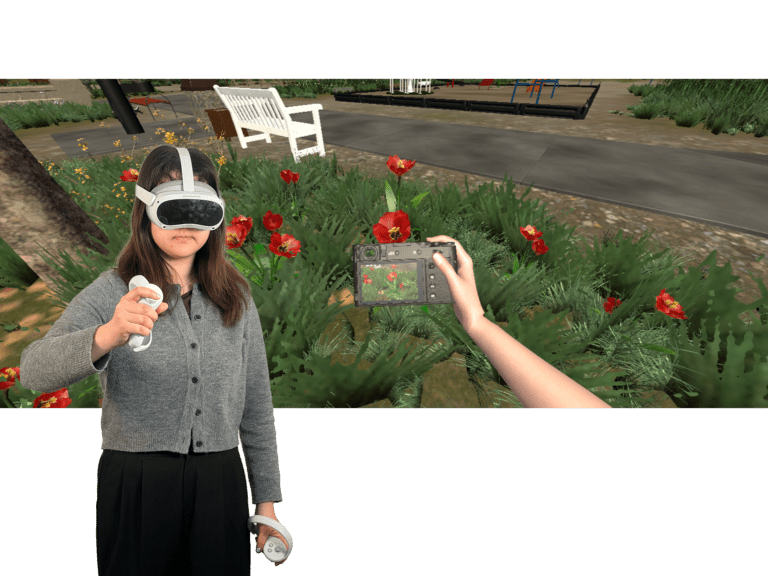
In the VR Coach smartsystem, patients move freely within a large park environment. Places are observed, described, and explored. Attention shifts outward rather than remaining only within repetitive thoughts.
Often, spontaneous reactions appear again for the first time: a longer look, a comparison, a preference. VR therapy is deliberately used here for resource activation in depression.
Perceive and retain positive impressions
Using a camera, different scenes can be photographed. Some elements respond — flowers begin to bloom or details change.
The photos then appear on a photo wall. There they are selected and linked to personal resources.
The selected image can be printed in the real world and serves as a concrete reminder outside the session.

Refocus attention in VR therapy
Different tasks stimulate perception and curiosity:
- photographing and rediscovering motifs
- collecting hidden chess pieces that appear on a chessboard
- recognizing shapes in clouds
- rowing on the lake
Often tasks continue without prompting, or patients formulate their own goals. Attention remains longer on impressions and shifts less automatically to negative content.
Anchor positive experiences physically
Selected impressions are located in the body and allowed to expand. Perception is therefore not only described but physically experienced.


Immersive natural environments as a complementary therapy component
360° nature environments are often used as a calm beginning or ending to a session, for example for short mindfulness or relaxation exercises. They complement the interactive scenarios but are not the central element.
Encountering the dolphin: experiencing embodiment and a sense of agency
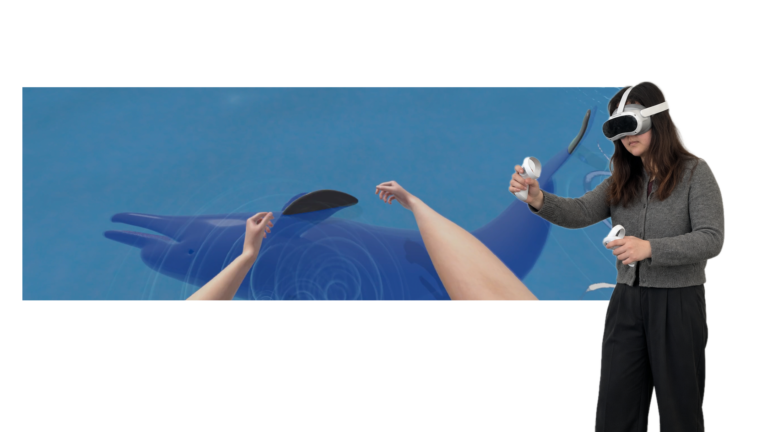
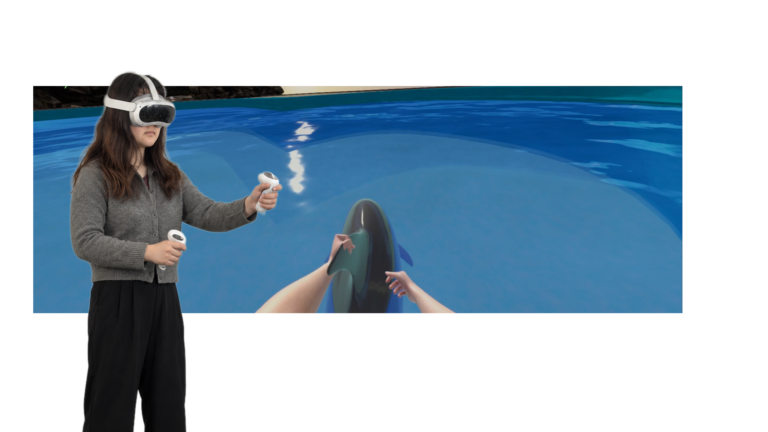
In a calm underwater environment, patients encounter a dolphin that responds to their movement, touch and proximity. Unlike the park scenario, the focus is not on exploration but on direct encounter: the dolphin turns when touched, swims towards patients and can be held on to.
The experience of agency — one’s own actions produce a visible reaction — is particularly engaging for patients who bring little initiative to the start of treatment. The encounter is low-threshold: there is no task to complete and no expectation.
Accompanying and calibrating the encounter in real time
Therapists control the dolphin’s behaviour using a slider for swimming speed and four buttons: Keep swimming, To player, Stand up. The pace can be adjusted at any time — from a gentle glide to an active pull through the water — without interrupting the experience.
Integrate VR therapy into treatment in a targeted way
Therapists accompany the process directly: from orientation to curiosity and personal reflection. Sequences can be recalled or varied again without performance pressure.
The application is often used as an introduction to activation, between sessions, or as support in relapse prevention.
Advantages of VR therapy for depression
VR therapy creates an activating and motivating approach to the treatment of depression. Through positive experiences and targeted tasks, attention, self-efficacy, and emotional responses are enhanced.
The focus is not on confrontation, but on strengthening personal resources and new possibilities for action.
VR therapy is also used for phobias, obsessive-compulsive disorders, and addiction.

Content and possible applications
An overview of all available exercises and therapeutic applications can be found in the catalog. Many institutions first use it for orientation and then discuss together how it can be integrated into their treatment concept.
An accompanying professional article with initial evidence data is also available.
Order your catalog with price list now – without obligation
Inside you will learn:
- Which content the individual modules offer
- How you can test the smartsystem
- Which VR headsets are compatible
- All hardware and software prices
After submitting the form, we will send you the catalog and price list promptly by email.

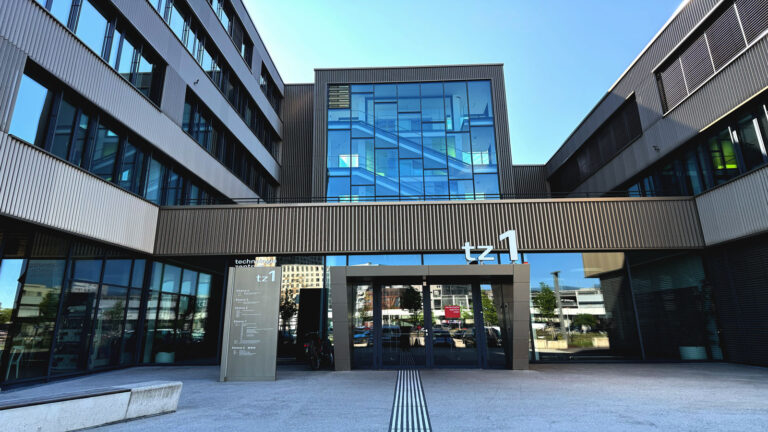
Or visit our showroom and try the module on site.

Frequently asked questions about VR therapy - briefly explained for clinics and practices
Who is VR therapy for depression suitable for, and when is it not?
Indications for VR therapy in depression: suitability and limitations
VR therapy for depression is particularly suitable when classical activation interventions fail due to pronounced lack of motivation. The low-threshold entry — with no performance requirements — enables access to positive experiences even during acute phases. It is not recommended in cases of acute suicidality or active psychotic symptoms.
An overview of all system options is available on the Smartsystem Variants page.
Is there scientific evidence for VR therapy in depression?
Evidence base for VR therapy in depression: resource activation and nature exposure
The evidence is positive: studies confirm the effectiveness of VR-based resource activation, nature exposure and cognitive bias modification in depressive disorders — particularly with regard to mood, attentional reorientation and the experience of self-efficacy.
Articles and further information on the evidence base can be found in the VR therapy in depression topic hub.
What distinguishes VR resource activation from classical behavioural activation?
VR resource activation vs. classical behavioural activation in depression
Classical behavioural activation relies on the conscious planning of pleasant activities — a step that often fails when motivation is severely lacking. VR creates access through direct experience: patients encounter positive reactions before having to plan or anticipate them cognitively. Activation does not arise as a decision, but as a lived moment.
VR therapy is also used to treat phobias, addiction disorders, and PTSD.