VR therapy for depression: activate resources and enhance motivation
The complement to classical cognitive behavioral therapy
Activate resources in depression in a targeted way.
With the smartsystem, the patient remains in a familiar environment while still being actively engaged.

How VR therapy is used for depression
At the beginning, little often happens: patients stand in the park and react only minimally. After a short time, a detail is described — a sound, a color, or an object.
Curiosity emerges from this, followed by movement.
This moment, when perception begins to return, can be accompanied during the session and revisited again.


Activate resources instead of creating pressure
In the VR Coach smartsystem, patients move freely within a large park environment. Places are observed, described, and explored. Attention shifts outward rather than remaining only within repetitive thoughts.
Often, spontaneous reactions appear again for the first time: a longer look, a comparison, a preference. VR therapy is deliberately used here for resource activation in depression.
Perceive and retain positive impressions
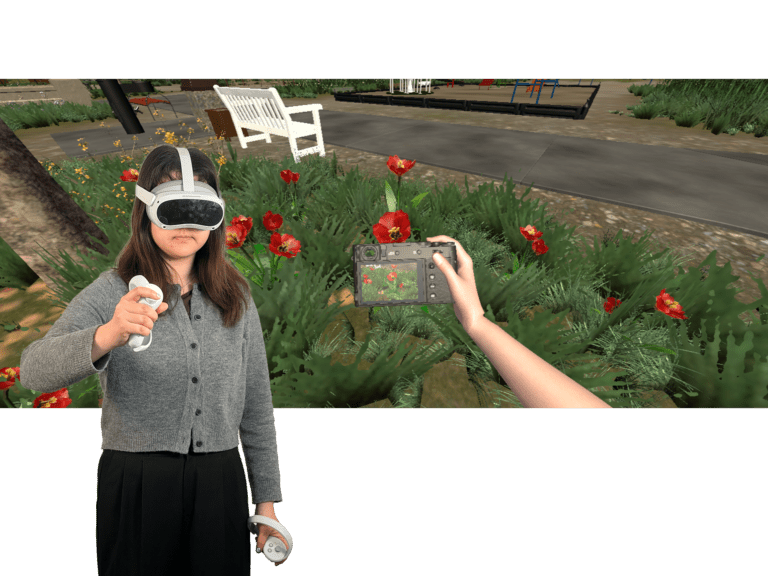
Using a camera, different scenes can be photographed. Some elements respond — flowers begin to bloom or details change.
The photos then appear on a photo wall. There they are selected and linked to personal resources.
The selected image can be printed in the real world and serves as a concrete reminder outside the session.

Refocus attention in VR therapy
Different tasks stimulate perception and curiosity:
- photographing and rediscovering motifs
- collecting hidden chess pieces that appear on a chessboard
- recognizing shapes in clouds
- rowing on the lake
Often tasks continue without prompting, or patients formulate their own goals. Attention remains longer on impressions and shifts less automatically to negative content.
Anchor positive experiences physically
Selected impressions are located in the body and allowed to expand. Perception is therefore not only described but physically experienced.


Immersive natural environments as a complementary therapy component
360° nature environments are often used as a calm beginning or ending to a session, for example for short mindfulness or relaxation exercises. They complement the interactive scenarios but are not the central element.
Integrate VR therapy into treatment in a targeted way
Therapists accompany the process directly: from orientation to curiosity and personal reflection. Sequences can be recalled or varied again without performance pressure.
The application is often used as an introduction to activation, between sessions, or as support in relapse prevention.

Advantages of VR therapy for depression
VR therapy creates an activating and motivating approach to the treatment of depression. Through positive experiences and targeted tasks, attention, self-efficacy, and emotional responses are enhanced.
The focus is not on confrontation, but on strengthening personal resources and new possibilities for action.
VR therapy is also used for phobias, obsessive-compulsive disorders, and addiction.

Content and possible applications
An overview of all available exercises and therapeutic applications can be found in the catalog. Many institutions first use it for orientation and then discuss together how it can be integrated into their treatment concept.
An accompanying professional article with initial evidence data is also available.
Order your catalog with price list now – without obligation
Inside you will learn:
- Which content the individual modules offer
- How you can test the smartsystem
- Which VR headsets are compatible
- All hardware and software prices
After submitting the form, we will send you the catalog and price list promptly by email.